Google Maps AI Update Marks a Major Shift
For more than a decade, Google Maps AI update improvements have mostly been incremental. Features like real-time traffic, Street View, and navigation refinements have enhanced usability without changing the core experience.
Now, that is changing.
With its latest update, Google is introducing one of the most significant transformations in the history of Google Maps.
This update combines artificial intelligence, immersive navigation, and conversational search, signaling a new era for mapping technology.
From Navigation Tool to Intelligent Assistant
Traditionally, Google Maps has functioned as a navigation tool.
Users enter a destination and receive directions.
The new update changes that model.
Google Maps is evolving into an intelligent assistant that understands not just where users want to go, but also why they want to go there.
This shift reflects a broader trend in technology.
Introduction of Ask Maps Feature
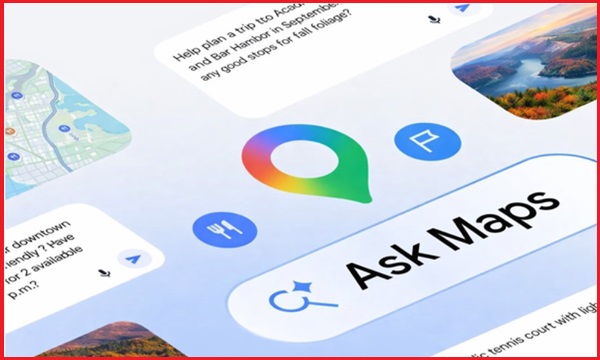
At the core of the update is a new feature called Ask Maps.
This feature is powered by Google’s Gemini AI models.
Instead of typing simple keywords, users can now ask questions in natural language.
For example:
- “Find quiet cafés with Wi-Fi”
- “Plan a scenic road trip”
- “Best places for dinner with outdoor seating”
The system interprets the request and generates personalized results.
How Ask Maps Works
Ask Maps uses data from:
- Location listings
- Reviews and ratings
- Photos
- User activity
It then combines this data to generate contextual recommendations.
Unlike traditional search, this approach focuses on intent rather than keywords.
A New Way to Discover Places
The Google Maps AI update introduces a more dynamic discovery process.
Instead of scrolling through lists, users receive curated suggestions.
This makes planning:
- Trips
- Outings
- Daily commutes
Much easier and faster.
Privacy and Personalization
Google has emphasized privacy in this feature.
Ask Maps primarily uses data already available within the Maps ecosystem.
This includes:
- Search history
- Location preferences
It avoids pulling unnecessary data from unrelated apps.
This approach balances personalization and privacy.
Immersive Navigation Enhances Driving Experience
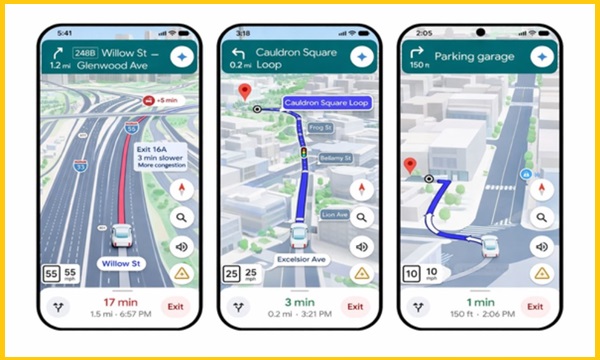
Another major highlight is Immersive Navigation.
This feature transforms the visual experience of navigation.
It introduces:
- 3D-style maps
- Realistic road previews
- Detailed intersection layouts
This helps users better understand their surroundings.
Real-World Visualization
The immersive system uses:
- Street View data
- Aerial imagery
- AI processing
This creates realistic previews of routes.
Users can see:
- Buildings
- Traffic signals
- Lane markings
Before they even start driving.
Smart Navigation Improvements
The Google Maps AI update also improves navigation instructions.
Instead of basic directions, users receive contextual guidance.
For example:
- “Turn right after the gas station”
- “Stay in the left lane for the exit”
This makes navigation more intuitive.
Smart Zoom Feature
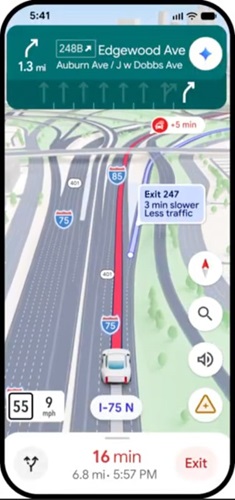
A new smart zoom function automatically adjusts map detail.
It highlights important areas such as:
- Intersections
- Highway exits
- Complex routes
This reduces confusion during navigation.
Evolution of Digital Maps
This update reflects a broader shift in mapping technology.
Maps are no longer just static tools.
They are becoming:
- Interactive platforms
- Planning assistants
- Discovery engines
This transformation is driven by AI.
Integration of Gemini AI
The update highlights the role of Google’s Gemini AI.
Gemini is being integrated across multiple services, including:
- Docs
- Gmail
- Android
Adding it to Maps extends its capabilities to location-based tasks.
Why Maps Is Ideal for AI Integration
Google Maps has access to vast amounts of data.
This includes:
- Billions of locations
- User reviews
- Traffic patterns
- Navigation routes
This makes it a perfect platform for AI-driven insights.
Competition in the Mapping Industry
Google Maps faces competition from:
- Apple Maps
- Waze
- HERE Technologies
Each platform offers unique features.
However, Google’s AI integration could provide a strong advantage.
Impact on User Experience
The update significantly improves user experience.
Users can:
- Ask complex questions
- Get personalized suggestions
- Navigate with better clarity
This reduces the effort required to plan trips.
Implications for Local Businesses
The Google Maps AI update also affects businesses.
Previously, visibility depended on:
- Search rankings
- Reviews
Now, AI-generated recommendations may influence discovery.
Businesses need to focus on:
- High-quality content
- Accurate information
- Positive reviews
Changes in Discovery Process
Instead of fixed lists, users receive dynamic recommendations.
This means:
- Results may vary based on context
- Personalization plays a bigger role
This could reshape digital marketing strategies.
Technical Infrastructure Behind the Update
The immersive features rely on advanced technology.
This includes:
- Computer vision
- Machine learning
- Large-scale data processing
Google combines billions of images to create realistic maps.
Benefits of Immersive Mapping
Immersive mapping offers:
- Better route understanding
- Reduced navigation errors
- Enhanced user confidence
This is especially useful in complex urban areas.
Gradual Rollout Strategy
Google is rolling out the update gradually.
Initial availability includes:
- United States
- India
More regions will follow.
This phased approach ensures stability.
Platform Expansion
The update will expand to:
- Android devices
- iOS devices
- In-car systems
This includes platforms like:
- Android Auto
- Apple CarPlay
Future of AI in Navigation
The Google Maps AI update is just the beginning.
Future developments may include:
- Smarter route planning
- Real-time contextual insights
- Advanced predictive navigation
AI will continue to shape the experience.
Real-World Use Cases
This update is useful for:
Travelers
Planning trips with personalized recommendations.
Drivers
Navigating complex routes with better clarity.
Daily Users
Finding places quickly and efficiently.
Pros and Cons
Pros
- Advanced AI-powered search
- Immersive navigation visuals
- Improved user experience
- Better personalization
Cons
- Limited initial availability
- Learning curve for new features
- Dependence on data accuracy
The Google Maps AI update represents a major milestone. It transforms Maps from a navigation tool into a smart assistant. This change aligns with the future of AI-driven applications.